

A spreadsheet you kept six years ago is not a budget. It is a record of who you were becoming.
I found a file in my iCloud called TravelExpensesTracker2020. I made it when I still lived in Manila, before Madrid, before the businesses. Every Grab ride, every matcha, every 7-Eleven onigiri, typed in by hand with the rate I had that day.
01 ~ The file
The file I forgot about
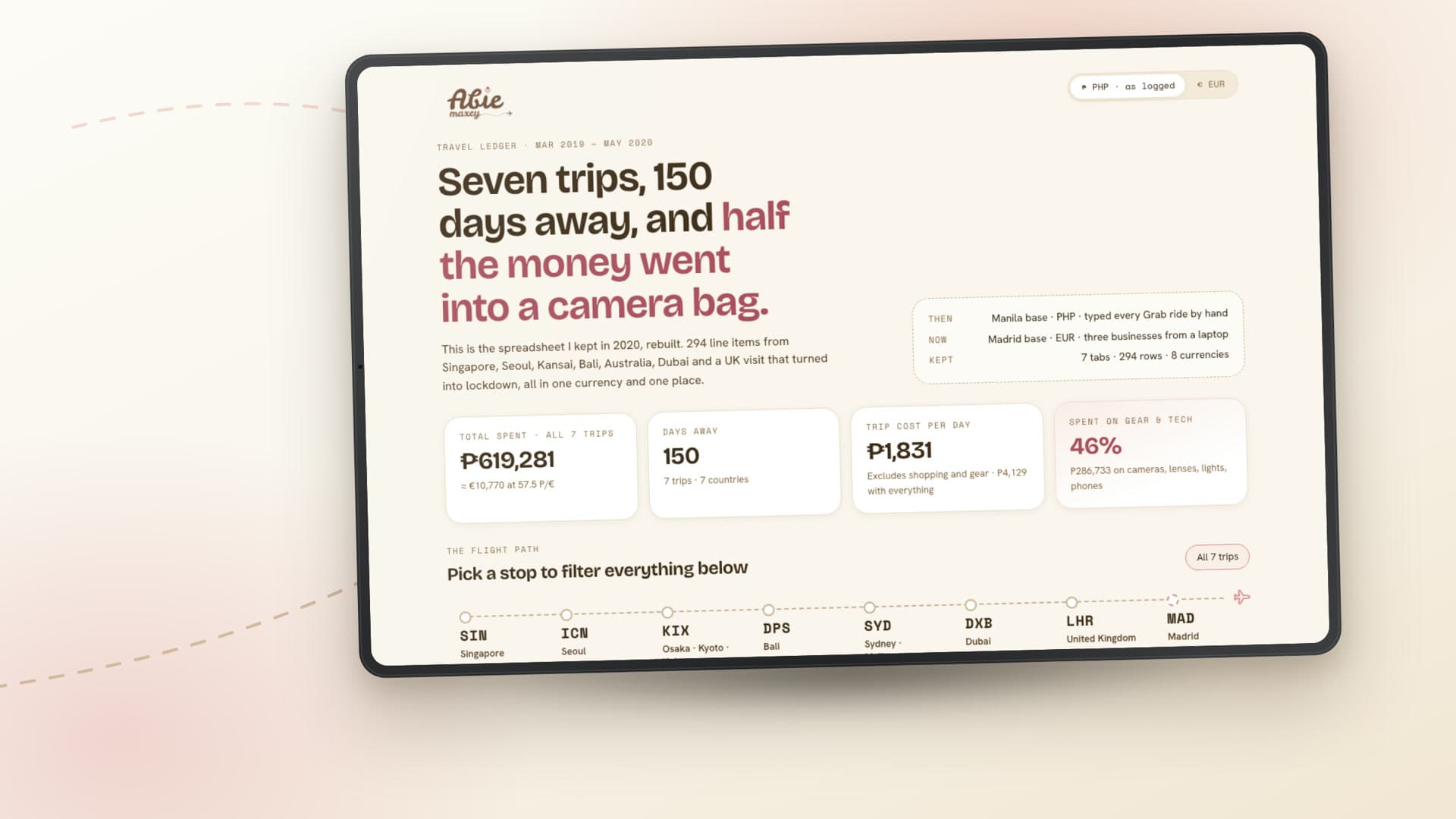
March 2019 to May 2020. Seven countries, 150 logged days, ₱619,281 in total.
The UK was supposed to be a short visit. Then March 2020 happened and it became a lockdown. One honest caveat on that line: I was there about six months, but only 85 days of it ever made it into the sheet. Once lockdown settled in I stopped logging, so the UK number is a floor and its per-day figure flatters me.
02 ~ The cleanup
First, the mess
A six-year-old spreadsheet is never clean. Nothing could be charted until this was sorted out:
13 swapped dates
The Kansai tab had day and month reversed. 10 June was typed as 6 October.
51 undated rows
Bali and the UK. They stayed in, marked undated, rather than quietly disappearing.
₱36,284 of cash
Money I exchanged and never itemized. It became its own line instead of vanishing into the total.
Refunds and statements
Refunded items count as ₱0, and the credit card tab was a statement, not a trip, so it was left out.
Every fix is listed at the bottom of the dashboard. That matters more than the charts. If you cannot see what was changed, you cannot trust the number at the top.
03 ~ The finding
The number that stopped me
46% of everything, ₱286,733, went to gear and tech. Not flights. Not hotels. Cameras, lenses, lights, a phone.
My own sheet had a cell labelled Total Camera: ₱135,689. An a6400 and a Sigma 16mm bought in Dubai in March 2020, then a Sony 10-18, a gimbal, a Rode mic and a wall of Hue lights during the UK lockdown.
I thought I was tracking trips. I was actually tracking the month I accidentally bought a studio.
04 ~ Credit where it is due
What past me did well
Strip out the shopping and the trips themselves were cheap. ₱1,831 a day across all seven. Bali ran ₱3,252 a day all in. Seoul was street food and a Tmoney card at ₱4,203 a day.
Stays came to ₱17,300 across the 150 logged days, under 3% of everything. Hostels, split Airbnbs, and people who took me in. One note in the Kansai tab still gets me: grateful for the free accommodation, breakfast and dinner. People are the best budget line there is.
05 ~ The leaks
Where the money leaked
Exchanged at airports and counters, spent on things that never made it into a row.
A room Google priced at ₱1,692 cost me ₱1,902 through a booking site. My note that day was just an angry line about the fee.
Every foreign swipe carried its own quiet fee, spread across four banks so I never saw the total.
My own note in the Australia tab reads: BEST FOREX, FIND A FRIEND. The next row says the opposite happened. Today a multi-currency card does the friend's job, and you decline every offer to pay in your home currency.
06 ~ The verdict
The honest verdict
Frugal traveler. Enthusiastic gadget buyer.
I ate at 7-Eleven to save ₱200, then bought a Kindle Oasis for ₱16,549. During lockdown alone there was about ₱25,000 of smart lighting, ₱16,000 of Echos and streaming sticks, and two sets of AirPods.
Some of it became the kit I still work with. Some of it was being stuck indoors with Amazon open. The sheet does not let me pretend otherwise.
07 ~ Your turn
Run this on your own sheet
Drop your spreadsheet or bank export into Claude and paste this. It is the exact order I worked in: look, clean, bucket, chart, then be honest.
Here is my expense spreadsheet. Before you chart anything:

1. Tell me what you found - tabs, date range, currencies, number of rows.
2. Clean it, and list every fix you make: swapped day/month dates, undated rows, refunds, cash withdrawals, split payments entered twice. Never drop a row silently.
3. Convert everything into one currency. Use the rate on each row if the sheet has one, and ask me for a rate if it does not.
4. Sort every row into three buckets - core costs, stuff, and investments. Ask me about any purchase over [YOUR AMOUNT] you cannot place.
5. Build me a dashboard: totals, cost per day for each trip or month, where it went by category, the biggest single buys, and the list of fixes.
6. Then tell me the truth. What I did well, where the money actually went, the leaks, and one habit to change.
That is a shared sample of mine: real amounts, with the notes column and the names of the people I travelled with taken out. Click any stop on the flight path and the whole page filters to that trip.
08 ~ Why it still matters
Why a 2020 sheet still matters
It is a floor, not a budget. The per-day numbers are the least a similar trip would cost today, so add a buffer for the years since and you have a planning baseline. It holds the origin story, because the gear line is the moment a travel budget turned into a business budget. And the structure still works: currency, rate, card used, who owes whom, and a notes column.
I am turning the whole process into a free Claude skill called Ledger. You drop in a spreadsheet or a bank export, it cleans the mess, sorts the spending, builds the dashboard, and then tells you the truth about it. It runs inside your own Claude, so your numbers never leave your machine.
Build it with meJoin Claude MaxxingLedger lands there first, with the build notes behind it.Go open your old sheet. A budget you abandoned, a tracker from a trip, a folder of bank exports you never looked at twice. It is not just a record of what you spent. It is a record of who you were becoming, written in numbers, before you had the words for it.
Mine said: she is about to start filming.

Love,
Abie